process briquette
🧱 1. What is a Briquette?A briquette is a block made from compressed charcoal powder.People use briquettes to:🔥 Cook BBQ (barbecue)🌬️ Smoke shisha (...
🧱 1. What is a Briquette?
A briquette is a block made from compressed charcoal powder.
People use briquettes to:
- 🔥 Cook BBQ (barbecue)
- 🌬️ Smoke shisha (hookah)
- ❄️ Heat their house
- 🏭 Power factory burners
Briquettes are popular because:
- They are clean (no smoke, no smell — if good quality)
- Long burning
- Cheaper than gas or electricity
- Eco-friendly
🌴 2. Raw Materials for Briquettes
1. Coconut Shell
✅ Strong, dry, hard = perfect carbon
→ Ideal for shisha and premium BBQ
2. Sawdust (Wood Powder)
✅ Cheap and easy to find
→ Used for industrial burners and budget BBQ
3. Hardwood Charcoal
✅ Very hot burn
→ Used in factories and some BBQ types
⚠️ Can produce more smoke
🏭 3. Step-by-Step Briquette Production
🔹 Step 1: Carbonization
Raw coconut shell or wood is burned without oxygen inside a drum or kiln.
The goal is to turn it into charcoal, not ash.
🛠️ Tools: Carbonization drum / Semi-modern kiln
✅ Why? No oxygen = pure black charcoal, not fully burned ashes
🔹 Step 2: Grinding
Charcoal is crushed into fine black powder.
🛠️ Tools: Hammer mill / Disc mill
✅ Why? Finer powder makes stronger, smoother briquettes
🔹 Step 3: Sieving
Powder is filtered to remove large chunks.
🛠️ Tools: Vibrating sieve
✅ Why? Uniform powder size gives clean shape and strong compaction
🔹 Step 4: Mixing
Charcoal powder is mixed with:
- Water
- Binder (usually tapioca flour)
🛠️ Tools: Horizontal mixer / Manual mixing tank
✅ Why? Binder acts like natural glue to hold the powder together
🔹 Step 5: Briquette Shaping
The mix is put into a machine to create different shapes:
Shape Used For
Cube Shisha
Hexagonal BBQ
Pillow BBQ/Home
Stick/Rod BBQ
🛠️ Tools: Hydraulic press (cube), Extruder (hex), Pillow press
✅ Why? Different markets demand different shapes
🔹 Step 6: Drying
Fresh briquettes are dried in the sun or inside a dryer.
🛠️ Tools: Sun drying racks / Oven dryer
✅ Why? Wet briquettes can grow mold or break inside the container
🔹 Step 7: Quality Control (QC)
We test:
- 🔥 Burning time (should be >1 hour for shisha)
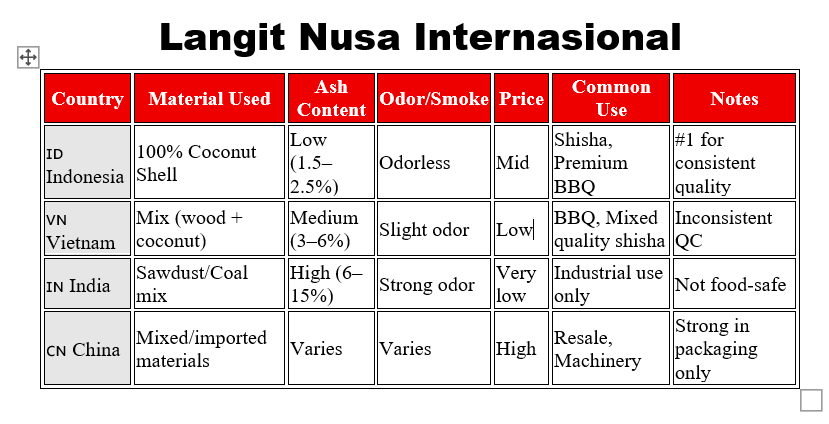
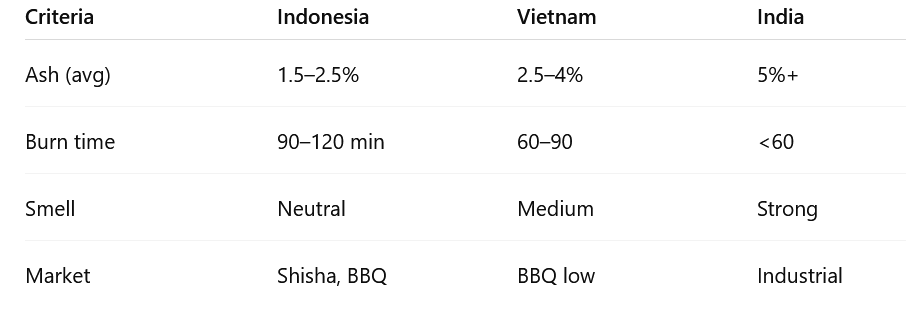
- 🌫️ Ash content (must be low — around 1.5%–2.5%)
- 💪 Strength (can’t break easily)
- 📏 Shape and size (must be consistent)
✅ Why? Buyers need stable, clean, repeatable performance
🔹 Step 8: Packaging and Export
🧠 What is Burning Time?
Burning Time is how long your briquette stays hot and burns before it turns into ash.
Why is it important?
- 🔥 If the briquette burns too fast → people must refill often = waste of money
- 💨 If it burns too slow but no heat → it’s useless
- 🍖 For BBQ → you want long, even heat
- 💨 For shisha → you want smooth, slow burn with no smoke or smell
Now, what actually affects the burning time?
Let’s break it down into 3 simple but powerful factors:
1. 🧱 Shape of the Briquette
The shape controls airflow, surface area, and heat distribution.
Shape Features Burning Time
🔲 Cube (26mm/25mm) Best for shisha, even sides, burns steady 90–120 minutes (avg)
🔷 Hexagonal Stick Has hole in the middle, good airflow 120–150 minutes (avg)
🟤 Round / Pillow / Oval More surface, burns faster, cheaper to make 45–90 minutes (avg)
🔍 Why it matters:
Cube is better when you want stable heat without spikes.
- Hex is better for long BBQ sessions.
- Round is often for industrial or budget buyers.
2. 💪 Pressing Pressure (Machine Force)
How strong the briquette is pressed during production.
Pressure Type Effect on Briquette Burning Result
🔨 Low Pressure Loosely packed, easy to break Burns fast, lots of ash
⚙️ Medium Pressure Decent quality, okay for short use 60–90 mins burning
🔩 High Pressure Strong, dense briquette = less oxygen Burns longer (90–150 mins)
⚠️ Caution:
Too much pressure without proper drying = briquette won’t light easily.
3. 💧 Moisture Content (Water in the Briquette)
Water is the enemy of fire.
Moisture Level What Happens Burning Result
❌ Too Wet (>10%) Hard to light, lots of smoke, crackling Weak burn, short time
⚠️ Medium (7–9%) Can work, but not ideal Average burn
✅ Perfect (5–6%) Lights fast, burns steady, clean smoke Long, clean burning
🔥 Pro Tip:
Best moisture for export-grade briquette = 5%
At Langit Nusa, we always test each batch before packing.
📊 Comparison Table: Cube vs Hexagonal
Factor Cube (26mm) Hexagonal Stick
Shape Square, compact Stick with center hole
Burning Time (avg) 90–120 minutes 120–150 minutes
Use Case Shisha / Hookah BBQ
Airflow Moderate Excellent
Heat Level Medium-high High, strong heat
Ash Very low (1.5–2.5%) Low to medium
🧠 Real Example:
Let’s say you’re buying for a shisha lounge — you want:
✅ Cube
✅ High-pressure pressed
✅ 5% moisture
✅ Made from 100% coconut shell
But if you’re buying for BBQ in Japan or Korea, then:
✅ Hex stick
✅ Long burning
✅ High carbon content
Briquettes are packed like this:
Shape Square, compact Stick with center hole
Burning Time (avg) 90–120 minutes 120–150 minutes
Use Case Shisha / Hookah BBQ
Airflow Moderate Excellent
Heat Level Medium-high High, strong heat
Ash Very low (1.5–2.5%) Low to medium
🧠 Real Example:
Let’s say you’re buying for a shisha lounge — you want:
✅ Cube
✅ High-pressure pressed
✅ 5% moisture
✅ Made from 100% coconut shell
But if you’re buying for BBQ in Japan or Korea, then:
✅ Hex stick
✅ Long burning
✅ High carbon content
Briquettes are packed like this:
- Plastic inner wrap
- Inner box
- Master box
- Pallet
- Container
🛠️ Tools: Sealer, strapping machine, forklift
Documents included:
- MSDS (Material Safety Data Sheet)
- MSDS stands for Material Safety Data Sheet.
It is an official document that explains how safe your product is and how to handle it — especially during shipping.
Think of it as a health & safety report for your product. - 📦 What does MSDS contain?
For briquettes, an MSDS usually includes:
Section Explanation
Product Name What kind of briquette it is (e.g., Coconut Charcoal Cube)
Chemical Composition What it’s made of (e.g., 100% Coconut Shell Charcoal, Binder: Tapioca)
Flammability Is it easy to catch fire? Yes — but only when lit properly
Toxicity Is it poisonous? No — but must not be inhaled when burning in closed room
First Aid Instructions What to do if dust gets in eyes or you breathe too much smoke
Storage Guidelines Keep dry, don’t store near flammable liquids
Handling Instructions Use gloves when handling large volumes
Transport Classification It’s usually listed as non-hazardous goods, but must be declared
📌 Why do buyers need MSDS?
- To show customs the product is safe and legal
- To avoid delays or rejection at the destination port
- To ensure your buyer can resell or store safely
- Fumigation certificate
Fumigation is a process where the container or packaging is treated with gas to kill any pests (like bugs, termites, or eggs) that might be hiding in wooden packaging or pallets.
Especially needed when you use wooden pallets or wooden packaging.
🧾 What is a Fumigation Certificate?
It is an official document that proves your product and packaging were cleaned from insects or pests before shipping.
📌 Why is fumigation important?
Especially needed when you use wooden pallets or wooden packaging.
🧾 What is a Fumigation Certificate?
It is an official document that proves your product and packaging were cleaned from insects or pests before shipping.
📌 Why is fumigation important?
- Some countries (like Australia, USA, EU) have strict rules — they don’t allow wood or packaging that might carry insects
- Without this, your shipment can be rejected, returned, or destroyed
- Certificate of Origin
A Certificate of Origin is a document issued by your local Chamber of Commerce that proves:
“This product was made in Indonesia.”
📄 What does it contain?
Part Example
Exporter Info Your company (e.g., Langit Nusa)
Importer Info The buyer abroad
Description of Goods Coconut Charcoal Briquettes – Cube 26mm
HS Code 4402.90 (for charcoal products)
Origin of Goods Indonesia
Signature & Seal From authorized government/chamber official
📌 Why is it important?
“This product was made in Indonesia.”
📄 What does it contain?
Part Example
Exporter Info Your company (e.g., Langit Nusa)
Importer Info The buyer abroad
Description of Goods Coconut Charcoal Briquettes – Cube 26mm
HS Code 4402.90 (for charcoal products)
Origin of Goods Indonesia
Signature & Seal From authorized government/chamber official
📌 Why is it important?
- Helps buyers get import tax discounts (especially in trade agreements)
- Used by customs to confirm the product is not from restricted countries
- Builds trust that your product is 100% Indonesian-made
✅ Final Summary (Simple Table)
Document Purpose When Needed
MSDS Prove your product is safe and legal to ship Almost always
Fumigation Cert. Prove there are no insects/pests in the packaging If using wood or on request
CO (Origin) Prove your product is made in Indonesia Always
🧠 Key Notes for Beginners
- Grinding affects texture
- Press machine affects shape and strength
- Drying affects mold risk and burning quality
- QC affects buyer satisfaction
If one step is wrong, the whole product will fail — and the buyer won’t return.
🧾 Final Words
Good briquettes don’t just “look nice”.
They must:
- Burn longer
- Ash less
- Stay strong
- And pass tests every time
“No matter how great your marketing is, in this business: the real king is burning performance. That’s what makes people reorder.”
🌟 Why Langit Nusa?
At Langit Nusa, we apply everything I’ve learned in 30 years — every test, every mistake, every upgrade.
We offer:
- ✅ 100% Coconut shell or hardwood charcoal
- 🔥 Long burn, low ash, no odor
- 📦 Private label (OEM), neat packaging, and full documents
- 🌍 Export-quality from Indonesia
Whether you're a distributor, a wholesaler, or just starting out — we’re here to help you grow with briquettes that truly perform.
Welcome to Langit Nusa — your reliable charcoal partner.
Tags
#education